Sustainability-related disclosure according to Article 10 of Regulation (EU) 2019/2088 in conjunction with Article 24 et seq. of Delegated Regulation (EU) 2022/1288
The subject of this document is mandatory information about the environmental and/or social characteristics of this asset management strategy. It is not marketing communication. This information is required by law to transparently explain the environmental and/or social features advertised by the asset management strategy.
Summary
No sustainable investment objective
This financial product promotes environmental or social characteristics but does not have as its objective sustainable investment.
Environmental or social characteristics of the financial product
This asset management strategy promotes environmental and social characteristics within the meaning of Article 8 of the Sustainable Finance Disclosure Regulation.
Environmental and social characteristics are taken into consideration when making investment decisions, including for example climate change and pollution in the area of environmental, as well as working conditions, health and safety in the area of social. In addition, aspects in the area of corporate governance are taken into account.
Investment strategy
The asset management strategy aims to achieve long-term value growth with due regard to socially and environmentally responsible investment criteria. Investments are made in securities that comply with the applied ESG exclusion criteria. ESG factors are integrated into investment decisions in order to ensure efficient risk management and to generate a sustainable, long-term return.
As part of the ESG exclusion process, investments which are associated with certain products or activities are excluded.
ESG risks and opportunities are considered when making investment decisions and throughout the holding period.
Proportion of investments
The asset allocation of the asset management strategy and thus the respective possible share of investments in specific assets can be found in the Investment Guidelines. The asset management strategy allocates to investments in category #1 Aligned with E/S characteristics as well as investments in category #2 Other. Investments in category #1 Aligned with E/S characteristics include investments in sub-category #1B Other E/S characteristics.
The asset management strategy can take both direct exposures in investee entities, in the form of equities and bonds, as well as indirect exposures to those entities, including in the form of equity- and bond-like securities, alternative investments, certificates and derivatives. In addition, liquid assets can be held. The investment strategy does not provide for a fixed minimum or maximum ratio of direct or indirect exposures or liquid assets.
Monitoring of environmental or social characteristics
The attainment of the promoted environmental and social characteristics is monitored by system-side checks for compliance with the binding elements of the investment strategy. The evaluation is based on data from an external data provider, which are provided in our systems on an automated basis. Underlying screens for this automated external data provision are defined and regularly reviewed internally.
Methodologies
As part of the ESG exclusion process, we determine whether investments associated with certain products or activities should be made. The applied ESG exclusion criteria represent a minimum standard to be investable for the portfolio.
Data sources and processing
To attain the environmental and social characteristics promoted by the asset management strategy, the following data sources are used:
- Exclusions and controversy monitoring based on data provided by MSCI ESG Research.
- ESG opportunity and risk analysis is based on internal research, exchanges with the companies, and data from external ESG data providers including MSCI ESG Research.
- Review of active target funds within a qualitative and quantitative analysis based on input collected from external asset managers via an internally developed questionnaire and personal discussions as well as sustainability assessments by recognised external agencies.
Limitations to methodologies and data
There may be limitations on the retrieval of data from data providers such as MSCI ESG Research due to their lack of coverage in the universe for certain investments, data errors, or methodological shortcomings. Where such misrepresentations are suspected we conduct internal review and potentially engage with the data providers to limit the impact on how the environmental and/or social characteristics promoted are met.
Due diligence
In addition to reviewing legal and contractual requirements as well as analysing financial metrics, the environmental and social characteristics of portfolio positions are taken into account depending on the ESG elements implemented in the asset management strategy.
The applied ESG exclusion criteria represent a minimum standard to be investable for the portfolio. The compliance with the applied ESG exclusion criteria is monitored by system-side checks for compliance.
A due diligence is being performed as part of the data procurement process when selecting data providers by subject matter and technical experts, incl. evaluation of portfolio and benchmark universe coverage, review of providers’ underlying models and frameworks, comparison of provider data with internal analysis and assessments.
Engagement policies
Part of the ESG integration and analysis within the asset management strategy is our work in the area of active ownership; whereby, we – as investors – attempt to exert a positive influence on companies with regards to their handling of ESG aspects.
No sustainable investment objective
This financial product promotes environmental or social characteristics, but does not have as its objective sustainable investment.
Environmental or social characteristics of the financial product
This asset management strategy promotes environmental and social characteristics within the meaning of Article 8 of the Sustainable Finance Disclosure Regulation.
Environmental and social characteristics are taken into consideration when making investment decisions, including for example climate change and pollution in the area of environmental, as well as working conditions, health and safety in the area of social. In addition, aspects in the area of corporate governance are taken into account.
Investment strategy
The asset management strategy aims to achieve long-term value growth with due regard to socially and environmentally responsible investment criteria. Investments are made in securities that comply with the applied ESG exclusion criteria. ESG factors are integrated into investment decisions in order to ensure efficient risk management and to generate a sustainable, long-term return.
As part of the ESG exclusion process, investments which are associated with certain products or activities are excluded.
ESG risks and opportunities are considered when making investment decisions and throughout the holding pe-riod. ESG analyses are performed as part of the portfolio review process:
- Monitoring of each individual stock with respect to various ESG issues including ESG controversies and business involvement.
- Regular critical-constructive dialogue with the company's management team.
- Early identification of issues that could raise ethical questions and potential risks, as well as trends and opportunities arising from ESG issues.
Qualitative and quantitative ESG data, from both bottom-up and top-down perspectives, are combined. This data can be retrieved from the following sources:
- Regular active engagement and detailed exchange with company management.
- Company publications (e.g. sustainability reports) and independently commissioned studies
- Expert opinions from industry experts as well as assessments of media reports and other publicly accessible sources
- Research from external data providers, including ESG reports on companies, overviews and assessments of controversies, Business Involvement Screenings, and others.
Using a combination of internal ESG analyses as well as external data, qualitative and quantitative assessments are created based on the sources described above, leading to an investment decision. Relevant ESG issues are openly discussed and monitored within the investment team and in dialogue with the ESG Office.
Another part of the ESG integration and analysis is our work in the area of active ownership; whereby, we – as investors – attempt to exert a positive influence on companies in regards to their handling of ESG aspects. This includes, among other things, so-called engagement (i.e., direct dialogue with companies on specific ESG aspects). Existent and/or potential ESG controversies and other ESG-relevant aspects are addressed in a structured engagement process. Based on this engagement, the portfolio management can determine whether a company/issuer acknowledges existent and/or potential problems and whether it is developing strategies both to solve these and to identify opportunities related to ESG/sustainability.
Good corporate governance practices of the companies invested in are assessed based on the following elements of the investment strategy:
- Application of norm-based ESG exclusion criteria and ESG controversy monitoring with exclusion of companies directly involved in ongoing very severe ESG controversies including governance practices and compliance with international norms
- Engagement with portfolio companies directly involved in severe ESG controversies
- ESG analysis based on internal research, exchanges with companies and data from external ESG data providers, covering, among others, governance practices.
Proportion of investments
The asset allocation of the asset management strategy and thus the respective possible share of investments in specific assets can be found in the Investment Guidelines. The asset management strategy allocates to investments in category #1 Aligned with E/S characteristics as well as investments in category #2 Other. Investments in category #1 Aligned with E/S characteristics include investments in sub-category #1B Other E/S characteristics.
The asset management strategy can take both direct exposures in investee entities, in the form of equities and bonds, as well as indirect exposures to those entities, including in the form of equity- and bond-like securities, alternative investments, certificates and derivatives. In addition, liquid assets can be held. The investment strategy does not provide for a fixed minimum or maximum ratio of direct or indirect exposures or liquid assets.
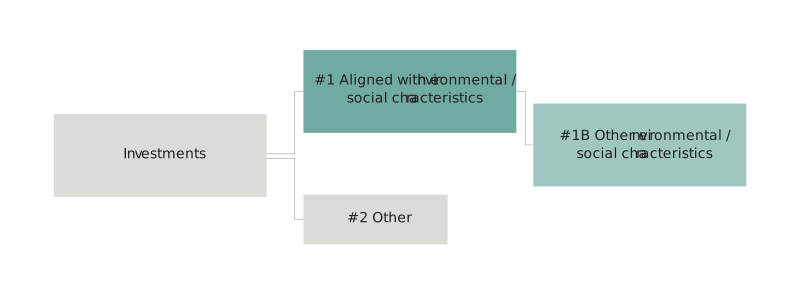
#1 Aligned with E/S characteristics includes the investments of the financial product used to attain the environmental or social characteristics promoted by the financial product.
#2 Other includes the remaining investments of the financial product which are neither aligned with the environmental or social characteristics, nor are qualified as sustainable investments.
The category #1 Aligned with E/S characteristics covers: The sub-category #1B Other E/S characteristics covers investments aligned with the environmental or social characteristics that do not qualify as sustainable investments.
The category "Other investments" includes liquid assets as well as investments in products used for hedging purposes or portfolio balancing and diversification.
Monitoring of environmental or social characteristics
The attainment of the promoted environmental and social characteristics is monitored by system-side checks for compliance with the binding elements of the investment strategy. The evaluation is based on data from an external data provider, which are provided in our systems on an automated basis. Underlying screens for this automated external data provision are defined and regularly reviewed internally.
The internal control of this monitoring and the underlying regulatory classification is carried out by the ESG Office, Portfolio Management, Compliance and Internal Audit, among others.
Methodologies
As part of the ESG exclusion process, we determine whether investments associated with certain products or activities should be made. The applied ESG exclusion criteria represent a minimum standard to be investable for the portfolio.
The attainment of the promoted environmental and social characteristics is measured through regular automated check on compliance with the binding elements of the investment strategy and with sustainability indicators based on these binding elements.
Data sources and processing
To attain the environmental and social characteristics promoted by the asset management strategy, the following data sources are used:
- Exclusions and controversy monitoring based on data provided by MSCI ESG Research.
- ESG opportunity and risk analysis is based on internal research, exchanges with the companies, and data from external ESG data providers including MSCI ESG Research.
- Review of active target funds within a qualitative and quantitative analysis based on input collected from external asset managers via internally developed questionnaire and personal discussions as well as sustainability assessments by recognised external agencies
To ensure data quality and to process data, the following measures are taken:
- A due diligence is being performed as part of the data procurement process when selecting data providers by subject matter and technical experts, incl. evaluation of portfolio and benchmark universe coverage, review of providers’ underlying models and frameworks, comparison of provider data with internal analysis and assessments,
- Furthermore, an engagement with data provider will take place in case of material changes to underlying data and/or data concerns,
- An automatic integration of provider data feeds into internal systems for portfolio management and monitoring purposes,
- Internal assessment and analysis of controversy data,
- As part of the ESG opportunity and risk analysis relevant data/ information from internal research is aggregated, exchanged with the companies, and validated with data from external ESG data providers.
- Input from external asset managers for review of active target funds within a qualitative and quantitative analysis is collected via internally developed questionnaire and personal discussions. This input is subsequently documented in an internal database, assessed for completion and analysed further within the framework. In case of missing or erroneous information, we may engage further with the respective asset managers and/or enrich with further externally collected information.
Estimated figures may be required e.g., in case of non-existent corporate disclosure and may be directly sourced from data providers. As coverage and methodologies change and further develop, a proportion of data that is estimated cannot be given.
Limitations to methodologies and data
There may be limitations on the retrieval of data from data providers such as MSCI ESG Research due to their lack of coverage in the universe for certain investments, data errors, or methodological shortcomings. Where such misrepresentations are suspected we conduct internal review and potentially engage with the data providers to limit the impact on how the environmental and/or social characteristics promoted are met.
When analysing active target funds, we depend on the accurate transmission of data from the external asset managers. Here we carry out plausibility tests on a random basis and verify the information in personal discussions.
Due diligence
In addition to reviewing legal and contractual requirements as well as analysing financial metrics, environmental and social characteristics of portfolio positions are taken into account depending on the ESG elements implemented in the asset management strategy.
The applied ESG exclusion criteria represent a minimum standard to be investable for the portfolio. The compliance with the applied ESG exclusion criteria is monitored by system-side checks for compliance. The evaluation is based on data from an external data provider, which are provided in our systems on an automated basis. Underlying screens for this automated external data are defined and regularly reviewed internally.
A due diligence is being performed as part of the data procurement process when selecting data providers by subject matter and technical experts, incl. evaluation of portfolio and benchmark universe coverage, review of providers’ underlying models and frameworks, comparison of provider data with internal analysis and assessments. An engagement with the data provider will take place in case of material changes to underlying data and/or data concerns.
Engagement policies
Part of the ESG integration and analysis within the asset management strategy is our work in the area of active ownership; whereby, we – as investors – attempt to exert a positive influence on companies with regards to their handling of ESG aspects. This includes, among other things, so-called engagement (i.e., direct dialogue with companies on specific ESG aspects). Based on this engagement, the portfolio management can determine whether a company/issuer acknowledges existent and/or potential problems and whether it is developing strategies both to solve these and to identify opportunities related to ESG/sustainability.
More detailed information on our engagement approach can be found in our publicly available policies.
Change history
01-01-2023
Publication of the sustainability-related disclosures in accordance with Article 10 of Regulation (EU) 2019/2088 in conjunction with Article 24 et seq. of Delegated Regulation (EU) 2022/1288.
15-10-2026
Update of the sustainability-related disclosures. Editorial adjustments and harmonization of individual formulations to ensure consistency between regulatory publications and clarification of the allocation of investments.