
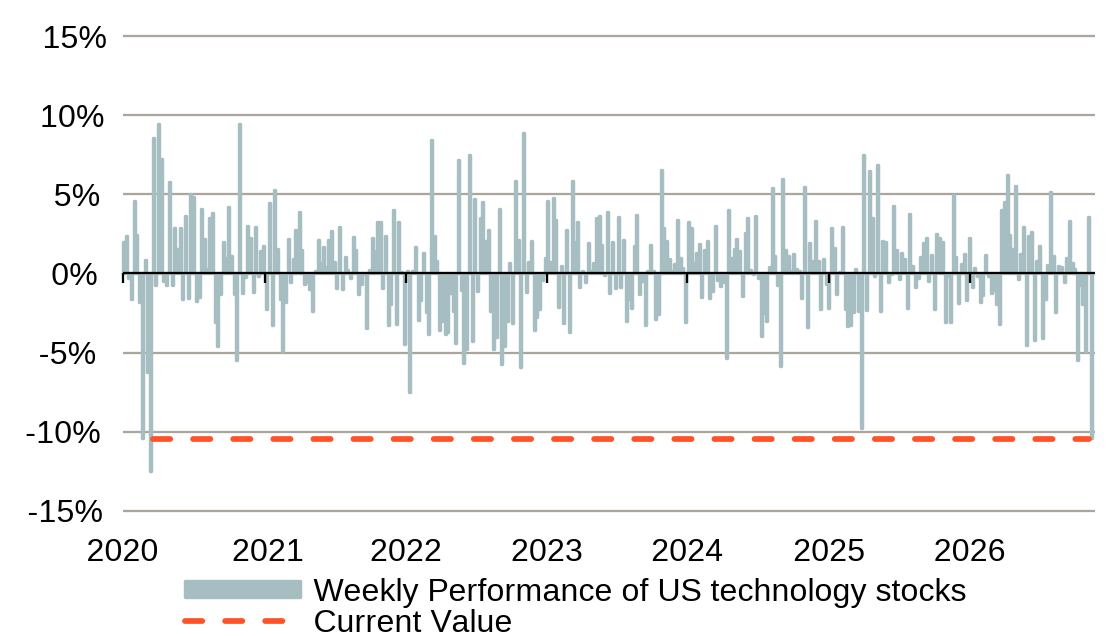
The “AI-angst” continues to hold markets firmly in their grip, triggering a broad-based sell-off last week. Equity markets recorded one of their worst weeks since the pandemic. Led by the technology sector, US equities fell by a full 8%. Following the sharp rise in volatility, quantitative investors were forced to reduce their portfolio risk and liquidate positions across the board: for example, even commodities such as gold and copper fell by almost 10%. Only government bonds and the US dollar were in demand as safe havens. The recent wave of selling appears increasingly sentiment-driven: fundamental catalysts that would justify such a sell-off were lacking last week, at least aside from the news surrounding Nvidia CEO Jensen Huang and comments from individual Fed members.
Looking ahead, we see the further downside potential for equities as limited. Firstly, both discretionary and systematic investors have already substantially reduced their equity allocations. Secondly, the risks associated with the sell-off in the AI sector appear increasingly priced in. At the same time, underlying macro as well as company fundamentals remain robust. Alongside positive year-end seasonality – which is also supported by seasonally strong corporate buyback programmes – this should provide renewed support for equities going forward.
Drivers behind the broad-based market correction
The reasons behind the sell-off over the past couple of weeks are manifold. The strong performance of the Democrats in the US midterm elections caused initial nervousness, particularly in the AI sector. These concerns are rooted in fears of tighter regulation under new Democratic governors in states crucial for data centres, such as Texas and Georgia. Broader AI concerns were recently further fuelled by the departure of Nvidia CEO Jensen Huang. Additional headwinds came from hawkish comments by individual Fed policymakers – most notably Governor Waller, who two weeks ago advocated a 50-basis-point interest rate hike at the December meeting.
However, the recent wave of selling appears primarily sentiment-driven – amplified by a series of technical factors. Following the already weaker market environment of recent weeks, rule-based momentum strategies (CTAs) were forced to substantially reduce their equity exposure. According to some estimates, these investors alone are likely to have sold around USD 57bn in equities. At the same time, due to the rise in realised volatility, volatility-targeting strategies also had to significantly reduce their risk and pare back equity positions accordingly.
In addition to the selling pressure from the systematic community, a historically negative gamma environment¹ amplified the downward price movements: options dealers had to hedge their sold protection (put options) by shorting corresponding equity futures in order to remain market-neutral – a process referred to in market jargon as delta hedging. In principle, upward as well as downward market movements are amplified because market makers² are forced to act pro-cyclically. With regard to last week, the already weak market trend was thus exacerbated once again. Following last Friday’s monthly options expiry, pressure from this side should at least ease somewhat, as many options have expired.
The equity sell-off is likely running its course
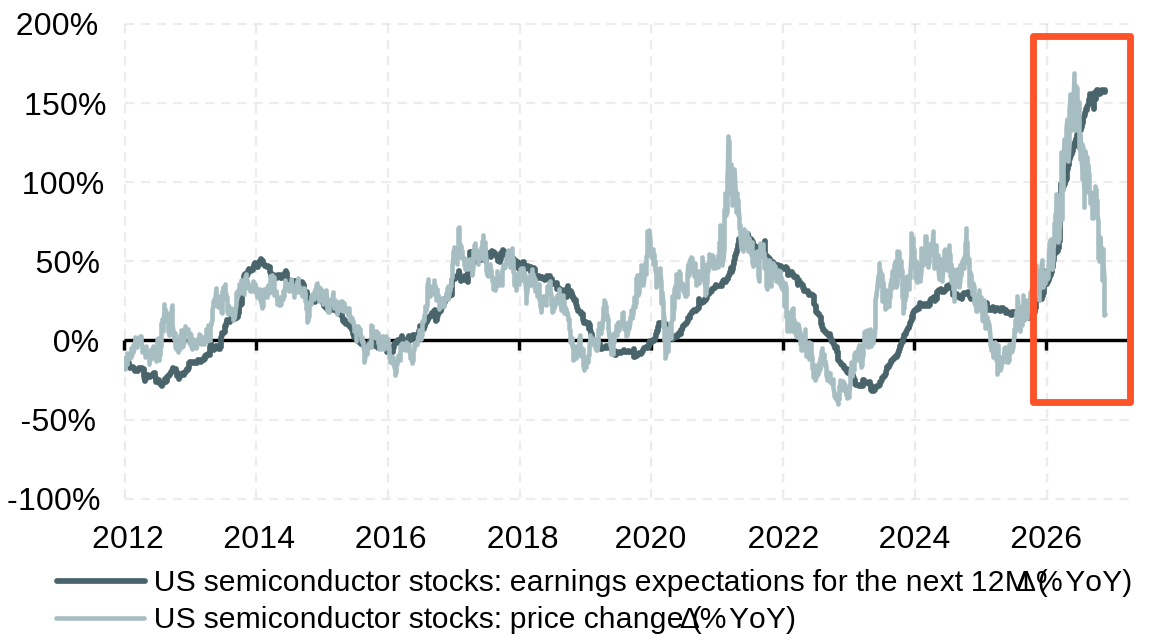
Looking ahead, we see the further downside potential in stocks as relatively limited, at least for now. While a portion of the current scepticism surrounding AI is certainly justified, these risks appear increasingly priced in. For instance, the price-to-earnings ratio of US technology stocks, at just under 14x, is at its lowest level since 2018 (by comparison, during the COVID-19 pandemic, the sector’s P/E ratio stood at 17x).
Some equities in this segment have now shed 50% or more from their late-summer highs. A significant deceleration in earnings growth is thus likely to be priced in by now. At the same time, both discretionary and systematic investors have already sharply scaled back their equity exposure. The bulk of the selling pressure stemming from these investor groups should therefore be behind us. Meanwhile, both macroeconomic and corporate fundamentals remain extremely solid. Combined with the supportive year-end seasonality, this should provide renewed support for equities.
At the same time, the headwinds for risk assets from the Federal Reserve are likely to ease over the coming months. Recent calls by individual Fed officials for a double-rate hike (by 50 bps) in December appear premature and excessive: compared to major rate-hiking cycles of the past, the US labor market is currently in equilibrium, and wage inflation remains contained. Furthermore, the now lower energy and commodity prices, combined with this year’s base effects, should dampen inflation prints next year and limit the Fed’s ability to deliver further rate hikes. The market has already priced out rate hikes over the past week. This indicates that the restrictive Fed trajectory is increasingly being seen as a policy mistake. In addition, with Beth Hammack and Lorie Logan, two of the most hawkish Fed policymakers, losing their voting rights next year, the influence of the "hawks" on the Committee is set to diminish. Overall, our economists therefore expect only two more US interest rate hikes of 25 bps each, in December and in March of next year.
Tech stocks post their strongest setback since Covid
Weekly performance of US-Tech stocks and last week’s performance
Markets appear to increasingly price in AI concerns
Semiconductors: Year-over-year percentage change in 12-month forward US earnings expectations versus price change
Notwithstanding recent turbulence, the outlook for 2027 supports a more neutral positioning
However, against a high base of comparison and already ambitious analyst forecasts, the bar is set high for corporate earnings to deliver another round of significant positive surprises next year. At the same time, global money supply growth is already decelerating, and following the Democrats' landslide victory, further fiscal stimulus – at least in the US – has become less likely. Given this complex backdrop, we see only moderate upside potential for equities in the coming year, even though the conclusion of the Fed's rate-hiking cycle should provide renewed support for stocks starting in the spring.
Accordingly, we have recently moved our multi-asset strategies and wealth management mandates to a significantly more neutral footing, and we are planning further adjustments. We will continue to scale back our sectoral overweights in cyclical sectors – which have performed exceptionally well so far in 2026 – such as banks, semiconductors and commodities. We have also already reduced our direct commodity exposure in anticipation of a mild economic slowdown in the coming year. To broaden our allocation, we are focusing on defensive equities within the healthcare, consumer goods, and telecommunications sectors. Following the recent strong performance of these defensive sectors, we are pacing our accumulation over the coming weeks to avoid acting pro-cyclically. Our overall stance remains constructive for the time being, maintaining an overweight allocation in nominal equity exposure.
Autoren

Ulrich Urbahn
Ulrich Urbahn is a CFA charterholder and, for many years, was part of one of the world’s top three multi-asset research teams in the renowned Extel survey. After earning degrees in economics and mathematics from Heidelberg University, he spent more than ten years at Commerzbank, where he worked, among other roles, as a Senior Cross-Asset Strategist. He has been with Berenberg since October 2017 and heads the Portfolio Management Liquid Alternatives & Solutions as well as the Multi Asset Strategy & Research departments. In addition, he is a voting member of the Investment Committee and is responsible for capital markets communication.

Dejan Djukic
Dejan Djukic heads up portfolio management at Berenberg. He is responsible for the discretionary mandates and the asset management solutions with multi-asset focus. He is a member of the Asset Allocation Committee and portfolio manager of various multi-asset strategies. After completing his Master’s degree in finance, he began his career at Commerzbank AG. Djukic was there responsible for asset allocation for asset management and fund mandates. He was also a voting member of the global investment committee and managed the bank's largest mutual funds and individual mandates. He then took over responsibility for portfolio management at DZ Privatbank S.A.. The team was responsible for the bank's large and special mandates.