
The geopolitical situation in the Middle East has dramatically escalated: after weeks of intense negotiations, threats and troop movements, Israel and the US have launched a pre-emptive strike against Iran. Initial reports suggested ‘surgical’ strikes, but President Trump's eight-minute video speaks of an ‘ongoing’ military operation with potential US casualties – ‘boots on the ground’, i.e. the actual presence of troops in the war zone, cannot therefore be completely ruled out, despite Trump's campaign rhetoric against protracted interventions before the mid-term elections. On basis of the current developments, we share a structured analysis of the potential impact on energy prices, equities, bonds and our portfolio setup.
Oil prices: Advance rise and Hormuz as a game changer
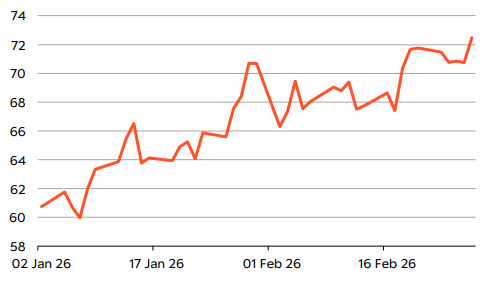
The markets have anticipated the conflict at least in part: Brent oil prices. The price of crude oil (Brent) has already risen significantly and traded even before the escalation at around USD 70-80 per barrel – an increase of around 20% since the start of the year. Historically, geopolitical shocks in the Middle East have often been followed by initial spikes increases of up to 10%, followed by profit-taking and lower prices in the medium term (the ‘sell-the-news’ effect).
However, the decisive risk is the Strait of Hormuz: around 20% of global oil flowsthrough this bottleneck between Oman and Iran, and a closure (as Iran is now threatening) could quickly drive the Brent oil price to USD 100 or more. Experts from Goldman Sachs and Deutsche Bank are warning of prices of up to USD 120, which would weigh on the global economy.
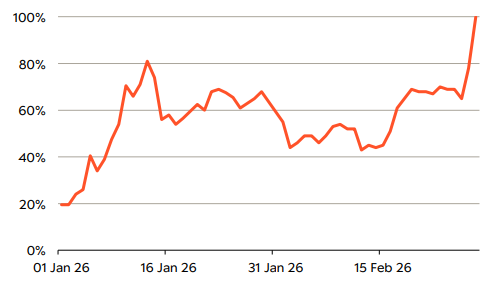
Betting markets already saw an increased risk of conflict
Polymarket probability for a US strike on Iran by June 2026
Brent crude oil has already risen sharply in recent weeks
Brent oil price in USD per Barrel
Equity markets: resilience in the base case, vulnerability in the event of a shock
Stocks have weathered geopolitical shocks well in the past: brief consolidation was often followed by minor, short-lived setbacks – even when oil prices spiked. Trump appears to be avoiding a sustained rise in oil prices and interest rates by targeting the destruction of the Iranian navy in order to minimise risks in Hormuz. Moreover, the attack on Iran came as no surprise, as it had been speculated about for some time. Since many market participants – including us – had already reduced their equity exposure in advance or hedged themselves on the options market, the downside potential for equities is likely to be limited for now.
However, if the price of oil remains high for months, there is a risk of higher interest rates and margin pressure: a setback similar to that seen in 2022 would be conceivable. However, this is not our base scenario. We are therefore maintaining our slight overweight position in equities and would view larger sell-offs as opportunities to increase our overweight position in equities – but we are also prepared to reduce it if a change in the oil regime with sustainably higher prices become apparent. Our overweight position in commodities and energy stocks also protects against price increases.We consider gold to be a safe haven, but not bonds
Government bonds are not automatically a ‘safe haven’ in an oil price shock, because inflation and, in some cases, inflation expectations can weigh on real yields. Gold, on the other hand, has historically performed strongly in such phases – our strategic overweight in this area positions us very advantageous in this regard.
Macroeconomic effects in the eurozone: inflation vs. growth
If Brent crude oil prices remained at USD 100 for several months, eurozone inflation would climb from its current level of around 1.7% to just under 2.5%–3.0%. The rule of thumb is that a 10% increase in oil prices is accompanied by an increase in inflation of around 0.2 percentage points. In addition, GDP growth would fall by 0.2-0.5 percentage points. Sentiment indicators such as the ifo Business Climate Index and the Purchasing Managers' Indices (PMIs) would plummet. With long-term inflation expectations stable, the ECB would look through short-term higher inflation rates and stick to its expansionary monetary policy (key interest rate 2%) – and possibly even implement interest rate cuts to support the economy. However, we do not expect a protracted war, as Trump's base is sceptical about distant military adventures. The US President must respond to the mood at home, especially as he is currently not doing well in the
polls ahead of the midterm elections on 3 November 2026 and wants to defend the Republican majority in the Senate and House of Representatives.
Conclusion
The capital markets are currently pricing in a transitional scenario in the Middle East conflict. Our portfolio allocation, with an overweight in equities and gold and an underweight in bonds, should prove robust. In our base scenario, we assume that the conflict will be short-lived and would tend to buy equity dips, viewing stronger dips in equities as an opportunity to increase our equity position. If, on the other hand, a longer conflict looms, we would take a more defensive stance in our portfolio.
Authors

Ulrich Urbahn
Ulrich Urbahn is a CFA charterholder and, for many years, was part of one of the world’s top three multi-asset research teams in the renowned Extel survey. After earning degrees in economics and mathematics from Heidelberg University, he spent more than ten years at Commerzbank, where he worked, among other roles, as a Senior Cross-Asset Strategist. He has been with Berenberg since October 2017 and heads the Multi Asset Strategy & Research as well as the Portfolio Management Alternatives departments. In addition, he is a voting member of the Investment Committee and is responsible for capital markets communication.