
In a nutshell
The Iran shock temporarily dampens the global economy.
A gradual return to normal growth.
Fiscal stimulus is supporting the German economy, but without new reforms, companies will continue to relocate.
Despite the AI boom, Trump’s policies are holding back the US economy.
Stable key interest rates, provided energy shock ends soon.
Iran shock briefly dampens the global economy
After a strong start to 2026, the war in Iran threw the economies of Europe and many emerging economies off course in the second quarter. Whilst the Eurozone and the UK appear to have slipped into stagflation, growth has also slowed in those Asian countries that are heavily reliant on energy imports from the Persian Gulf. In the US, which is itself a net exporter of energy resources, the damage is far less severe. Private consumers are also suffering from high oil prices. After a strong start to 2026, the war in Iran threw the economies of Europe and many emerging economies off course in the second quarter. Whilst the Eurozone and the UK appear to have slipped into stagflation, growth has also slowed in those Asian countries that are heavily reliant on energy imports from the Persian Gulf. In the US, which is itself a net exporter of energy resources, the damage is far less severe. However, private consumers are also suffering from high oil prices. Yet, neither President Donald Trump nor the regime in Iran appears to have any interest in a protracted conflict. We therefore expect that, following the Memorandum of Understanding from the 17 June, the Strait of Hormuz – which is vital for global trade – will not be closed again for any significant period. Consequently, the global economy should be able to recover from the setback caused by Iran in the second half of the year. Inflationary pressure is also likely to ease again in most countries. The current weakness in private consumption makes it difficult for companies to pass on higher costs in full to consumers.
USA: Consumption cannot sustain the economy much longer
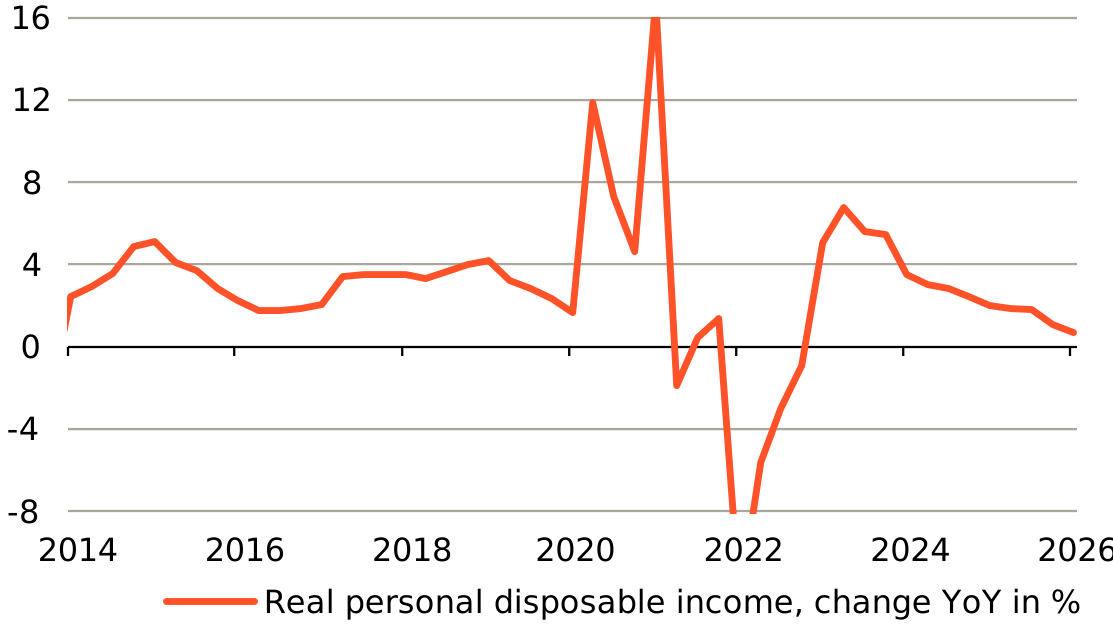
Consumers’ real purchasing power is barely increasing
Eurozone: renewed growth in autumn
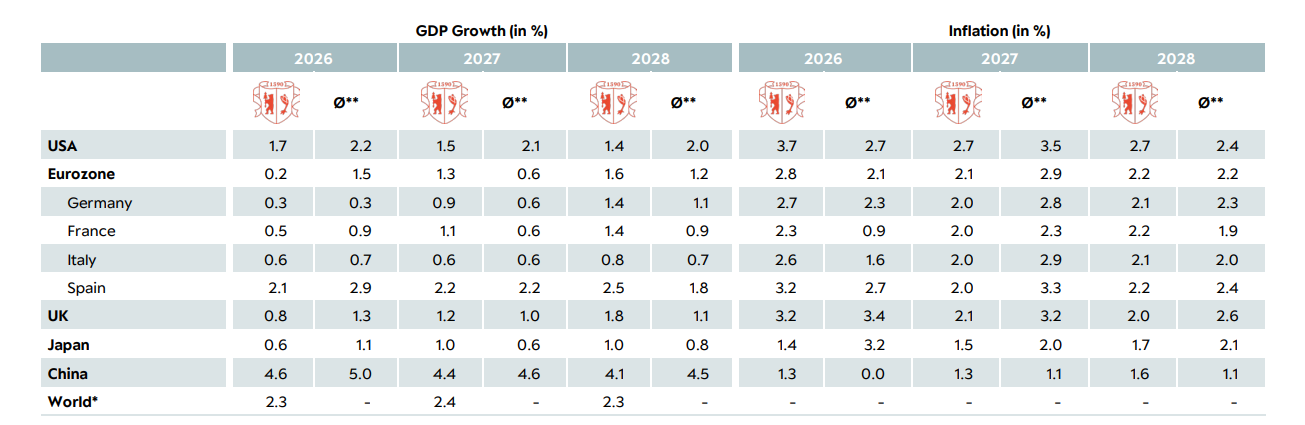
Despite Trump’s tariff chaos and the flood of Chinese exports, the Eurozone economy managed to grow at a normal pace in 2025. Excluding the volatile Irish data, which distorts the picture, the economy grew by 1.1%. However, high energy prices between March and May 2026, as well as widespread uncertainty over the outcome of the war in Iran, appear to have brought growth to a standstill in the second quarter. As it will likely take several months for the situation to return to some semblance of normality, growth is also expected to remain subdued in the third quarter. After that, the economy may regain momentum. For 2026 as a whole – excluding Ireland – growth of 0.6% could be achieved.
Germany: reforms must accompany the fiscal package
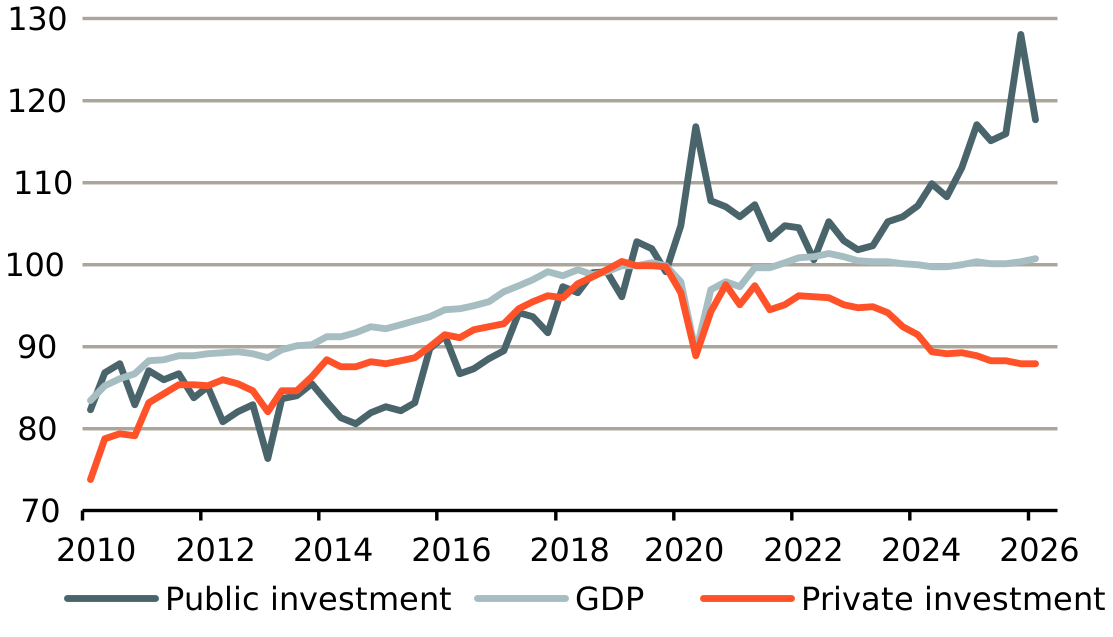
Whilst crisis-hit countries in southern Europe have emerged as the continent’s new drivers of growth, Germany’s persistent weakness is weighing on the outlook for Europe. In view of rising non-wage labour costs and high energy prices, as well as a shortage of skilled workers and uncertainty over the future direction of German economic policy, many companies are holding back on investment in Germany. Although increased spending on defence and infrastructure is increasingly supporting the economy, the ongoing decline in private investment has so far largely offset the rise in public spending. The reforms introduced so far, such as the ‘Investment Booster’ and the ‘Construction Turbo’, have not been sufficient to halt the exodus of many companies from Germany. However, should the government in Berlin put together a major reform package shortly, as planned, this could improve the outlook. Even if the reforms are not likely to be comprehensive, we nevertheless expect them to provide some positive impetus. Together with the continued rise in government demand, improved business conditions could stimulate private investment. Given the housing shortage, residential construction is also likely to contribute to growth from the autumn onwards. In 2027, the German economy could then grow by around 0.9%. A drop in unemployment could then provide a further boost to private consumption. An improvement in the German economy will also have a knock-on effect on other European countries, for which Germany often remains the most important trading partner. We therefore expect a mini-boom in the Eurozone in 2028, with a growth rate of 1.6% – which is likely to be above trend of 1.2%.
The German Problem
Public investment is rising – but private investment is falling
The US is gradually losing momentum
Higher tariffs, widespread uncertainty and the immigration ban are causing problems for many companies. The damage caused by Trump’s economic policies is evident in the gradual slowdown of the US economy. Although the recent tax cuts are likely to have provided significant support to the economy in the second quarter, the rate of growth is expected to stabilise at around 1.5% thereafter. Investment in AI is certainly helping. However, the US has to import a large proportion of the equipment from East Asia. So far, the boom in AI has provided a greater boost to Taiwan and South Korea than to the US itself. The benefits of AI are likely to boost economic productivity, particularly in the US, in the years to come. However, the effect is unlikely to be sufficient to offset the damage caused by the immigration ban. Many US citizens are grumbling about the inflationary impact of the war with Iran and the tariffs that Trump imposed in 2025. In the mid-term congressional elections on 3 November, Trump’s Republicans are therefore likely to lose their majority in one of the two chambers – the House of Representatives. After that, Trump could well continue to make many geopolitical headlines. But in terms of economic and fiscal policy, he would then be a lame duck for his final two years in office. This need not be a disadvantage for the US and global economies.
ECB and Fed holding steady, BoE could cut base rate end of 2026
Many central banks have responded to the surge in inflation triggered by the war in Iran. Contrary to Trump’s initial hopes, the new Chair of the US Federal Reserve, Kevin Warsh, did not ease monetary policy in June. The ECB has even raised its deposit rate by 25 bp to 2.25%. The financial markets expect the ECB and the Fed to tighten their monetary policy as the year progresses. However, the surge in inflation seen in recent months may gradually subside if oil prices continue to normalise. We therefore expect the Fed and the ECB not to raise interest rates in the second half of 2026. If wage pressures ease significantly, the BoE could even cut rates in December.
Growth and inflation forecasts
Author