
In a nutshell
Global stock indices post further gains in 2026 despite energy and interest rate shocks. Asian equities lead performance rankings – German stocks trail behind.
Strong corporate earnings and a buoyant US economy, combined with more structural factors such as decent money supply growth, are likely going to provide some tailwinds to equities over the coming months.
But stock markets are likely to remain volatile – not just because of the Gulf. Energy stocks, alongside AI-related sectors, remain key portfolio components.
Stocks are performing well – despite numerous headwinds
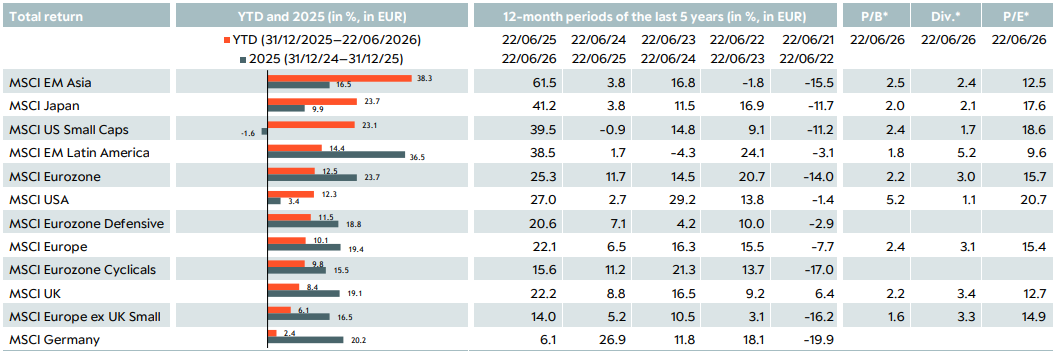
Global equity markets performed solidly in the first half of 2026. All three major equity regions (the US, Europe and Asia) have gained in value since the start of the year – despite geopolitical turmoil, rising interest rates and significantly higher energy costs. The market euphoria surrounding chips, AI and computing power became a key driver of the bull market. The market frenzy around AI laid the groundwork for a substantial, in some cases parabolic, rally in Asian stock indices. US stocks, too, benefited from the AI hype and reached new all-time highs. European (and in particular German) equity indices lagged behind global peers. There were two factors that held the pan-European markets back: firstly, as a net energy importer, the Eurozone economy is more severely affected by the recent rise in energy prices. Secondly, European equity indices are benefiting disproportionately less from the current AI frenzy.
Despite a very turbulent first half of the year, global stock indices have performed solidly – with German stocks bringing up the rear
Solid fundamentals are likely to continue to underpin share prices
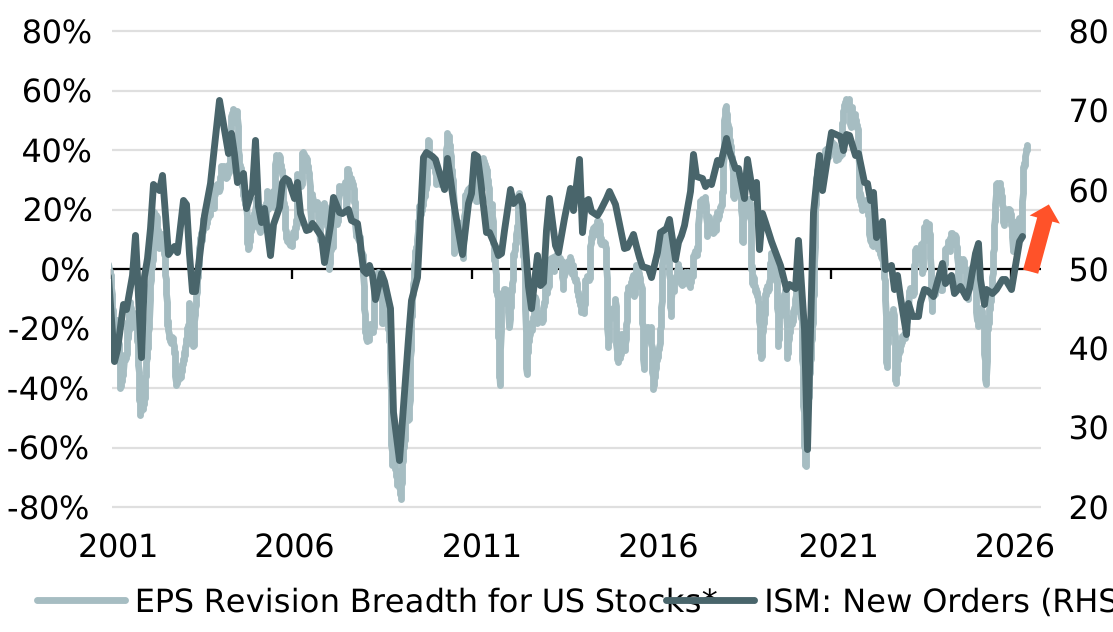
We expect equities to continue their rally in the second half of the year. This assessment is based primarily on strong fundamentals. For example, the rate of US earnings revisions is at one of its highest levels in the last 20 years. At the same time, leading indicators paint a very positive outlook for the US economy. Combined with more structural factors such as the growing money supply, globally expansionary fiscal policy and mechanically higher demand for equities driven by ETF savings plans, this is likely to support global equity benchmarks over the coming months – even if higher interest rates are likely to prevent significant valuation expansions.
Very strong fundamentals likely to further support share prices
Earnings revisions for US shares*: proportion of net earnings upgrades for US companies over the last three months
Interest rate and energy risks set to remain a factor for investors
The second half of 2026 is likely to be no less volatile than the first. The start of the campaign for the US midterm elections in November, further mega-IPOs in the US (Anthropic and OpenAI) and a change of leadership at the Fed are likely to keep market uncertainty high. Moreover, the situation in and around the Persian Gulf remains a key risk factor for global equity markets – even after the Memorandum of Understanding between the US and Iran. It is likely going to take months for commodity supplies from the Gulf region to return to normal. Also taking into account the very low inventory levels of oil and oil products, inflation and interest rate risks are therefore likely to stick with investors. In this environment, value stocks, such as banks and commodity stocks, remain essential portfolio components, both from an earnings and a diversification perspective.
European equities need a turnaround on the macro front
Alongside selective value segments, we continue to hold semi-conductors and other AI-related sectors as a portfolio overweight. Since the start of the year alone, token usage for common AI models has increased more than fivefold – a clear sign that the adoption of AI in the ‘real economy’ is in full swing. This almost secular growth driver is likely to continue to underpin AI-related sectors. On a regional level, the equity benchmarks of Asian markets, alongside their US peers, are set to benefit most from the ongoing implementation of AI. Alongside attractive valuations and the fact that international investors’ exposure is not overly excessive, this continues to support an overweight position in the region.
European equities need a clear macroeconomic catalyst to hold their own against their US and Asian counterparts. However, such a macroeconomic catalyst – be it a sudden normalisation of commodity supplies from the Gulf region or even peace in Ukraine – has yet to materialise. We therefore hold European equities at a level slightly below our benchmark allocation. Once these almost binary upside catalysts materialise, European equities are likely to offer investors solid upside potential compared with other regions.
Although volatility is likely to remain high, we expect equities to continue their rally. In this environment, the value segments mentioned above as well as AI-related stocks remain essential components of our multi-asset portfolios.
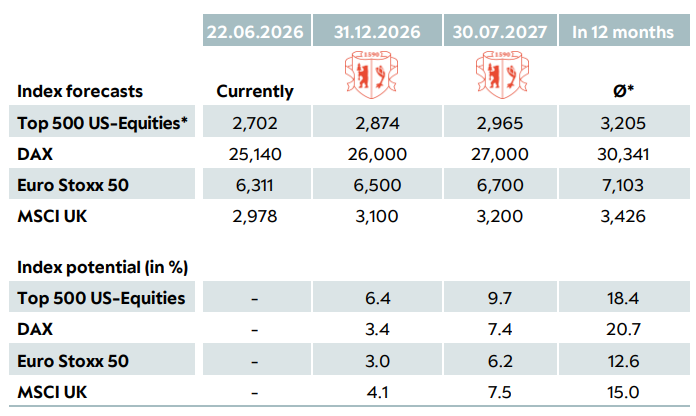
Forecast overview: volatile bull market will likely continue
A comparison of Berenberg’s and the consensus forecasts, figures for the end of 2026 and mid-2027
What is on companies’ minds?
Two topics currently dominate our discussions with companies: the unrelenting wave of AI investment and the consequences of the war in Iran. The heightened geopolitical uncertainty has channelled capital even more strongly towards AI beneficiaries considered to be structurally sound and with strong operational momentum – in particular semiconductors, network infrastructure, power supply and data centres. Traditional software stocks, by contrast, remained under pressure as investors have become more discerning in distinguishing between genuine AI monetisation and potential disruption caused by automated agents. Energy stocks benefited from rising oil prices following the outbreak of war in Iran, however, since the ceasefire, they have been held back by the prospect of a possible de-escalation and falling oil prices once again. Meanwhile, consumer-related stocks struggled with weak consumer sentiment and concerns about rising inflation due to higher energy and food prices. Within the industrial sector, a few strong niches emerged: US reshoring, electrification and suppliers for AI expansion. Healthcare stocks and utilities received little attention in the AI-dominated market. Generally speaking, growth is being rewarded, and uncertainty is only being overlooked where AI offers credible structural tailwinds. Thanks to the themes of AI and Iran, the US is currently leading the way on the stock market, whilst in Europe, alongside AI winners, banks have also recently been performing better again.
Peter Kraus, Head of Portfolio Management Equities
Author